

How to Use Retinol for Black Women: 10 Beginner-Friendly Steps
If you have been eyeing that little tube of retinol but you are not sure where to start, this guide is for you. Learning how to use retinol for black women over 40 is mostly about going slowly and respecting your skin barrier — because the same ingredient that smooths fine lines and fades dark…
If you have been eyeing that little tube of retinol but you are not sure where to start, this guide is for you. Learning how to use retinol for black women over 40 is mostly about going slowly and respecting your skin barrier — because the same ingredient that smooths fine lines and fades dark spots can also leave deeper skin tones dry, irritated, and patchy if you rush it. The 10 steps below walk you through it the gentle way, from the patch test to the first visible glow.
Retinol is a form of vitamin A that speeds up how fast your skin renews itself. That faster turnover is what softens fine lines, smooths texture, and fades the dark marks left behind by breakouts and sun. It is the most studied anti-aging ingredient there is, and it works beautifully on melanin-rich skin — but only when you introduce it with patience. Think of it as a long game, not a quick fix, and your skin will reward you for it.

1. Patch-Test First: How to Use Retinol for Black Women Without the Burn
Before retinol touches your face, test it somewhere it cannot do much damage. Dab a small amount behind your ear or along your jawline once a night for three nights and watch for redness, itching, or flaking. Deeper skin tones can develop post-inflammatory dark marks from irritation, so a patch test is not optional — it is the cheapest insurance your skin will ever get.

If the test spot stays calm after three nights, you are clear to move on to your face. If it stings or flakes, do not push through it — switch to a gentler formula, or buffer it with moisturizer first, which you will learn in step 6. A reaction on a hidden patch is a small inconvenience; the same reaction across your whole face is a week of hiding under makeup.
2. Start Low: Pick a Gentle Strength
Retinol comes in strengths, and the beginner mistake is grabbing the strongest one on the shelf. Start at 0.25% or a gentle encapsulated retinol — these are made to release slowly, so your skin gets the benefits with far less irritation. Drugstore tubes at this strength work just as well as expensive ones, and the money you save can go toward the moisturizer and sunscreen that make the whole routine work.

Look for words like “gentle”, “encapsulated”, or “beginner” on the label, and skip anything that promises overnight transformation — that is marketing, not skincare. Once your skin is comfortable after a month or two, you can step up to 0.5% if you want to. These affordable skincare products that actually work include several gentle starter options that pair well with a first retinol, so you do not have to rebuild your whole routine at once.
3. The Pea-Sized Rule: Less Is Truly More
Here is the part of how to use retinol for black women that most people get wrong: the dose. A pea-sized amount covers your entire face. Not a grape, not a generous squeeze — one pea. More product does not mean faster results; it means more irritation, more peeling, and more dark marks where the irritation was. Squeeze the pea onto your fingertip, dot it on your forehead, cheeks, chin, and nose, then spread it thin.

Keep it off the corners of your nose, the corners of your mouth, and the skin right under your eyes — those areas are thin, they dry out first, and they are where flaking usually starts. If the pea ever feels like too little, that feeling is the habit talking, not your skin. Your skin only needs that much, and it will tell you so by staying calm.
4. Night Only, on Clean, Dry Skin
Retinol belongs in your nighttime routine, never in the morning. Sunlight breaks it down and makes it less effective, and your skin is more vulnerable to sun damage while you are using it. Cleanse gently, pat your face dry, and wait a few minutes until your skin is fully dry — applying retinol to damp skin drives it deeper and faster, which sounds good until the redness shows up.

Use a mild, fragrance-free cleanser and lukewarm water, not a scrub or an exfoliating wash, on retinol nights. Your skin is doing enough work already. Dermatologists at the American Academy of Dermatology explain in their retinoid and retinol guide that a gentle routine around the product matters as much as the product itself, and that is doubly true for deeper skin tones.
5. Start Slow: Two Nights a Week, Then Build Up
The golden rule of retinol is to earn your way up. Week one and two: two nights a week, with rest nights in between. Week three and four: three nights a week if your skin is calm. From there, add a night every week or two until you reach nightly use — or stop at four or five nights a week if that is where your skin is happy. There is no prize for getting to nightly fastest, and rushing is how people end up quitting in week two with a peeling face.

Keep a simple note of which nights you use it, especially in the first month — it is easy to lose track and accidentally use it three nights in a row. If you ever wake up to stinging or visible flaking, take two nights off, moisturize well, and restart at the previous frequency. Your skin is not failing; it is asking for a slower pace, and listening is the whole skill.
6. The Sandwich Method: How to Use Retinol for Black Women on Sensitive Skin
If your skin is sensitive, reactive, or you have had irritation before, the sandwich method is your best friend. Apply a light layer of moisturizer first, wait a minute, then apply your pea of retinol, then seal it with another layer of moisturizer on top. The moisturizer on either side slows the retinol down just enough to take the edge off, and you still get the results — just with far less drama.

This method is especially kind to deeper skin tones, where irritation can leave dark marks that take months to fade. It also lets people who thought they “couldn’t use retinol” use it comfortably. Dermstore’s beginner guide to using retinol walks through the same buffering idea, and it is the technique most dermatologists suggest first when a patient is nervous about starting.
7. Moisturize Like You Mean It
Moisturizer is the safety net that makes how to use retinol for black women work without the flaking and tightness. Retinol speeds up cell turnover, and faster turnover means your skin barrier loses water more easily — so you have to put the moisture back. Use a ceramide-rich moisturizer every night, retinol night or not, and be generous with it. This is not the step to be stingy about.

Look for ceramides, hyaluronic acid, and glycerin on the label, and skip anything heavily fragranced while your skin is adjusting. A good moisturizer also makes the next morning look better — less tightness, less flaking, more glow. If you want to build the rest of your routine around this step, our guide to anti-aging skincare for Black women over 40 covers the moisturizers and supporting products that pair best with a retinol routine.
8. Sunscreen Every Morning — No Exceptions
Retinol makes your skin more sensitive to the sun, and sun exposure on retinol-treated skin is how dark spots get darker instead of lighter. Sunscreen every single morning is non-negotiable — SPF 30 or higher, a generous amount, on your face and neck, even on cloudy days and even if you are mostly indoors. On deeper skin tones, the right sunscreen also protects the glow you are working so hard to build.
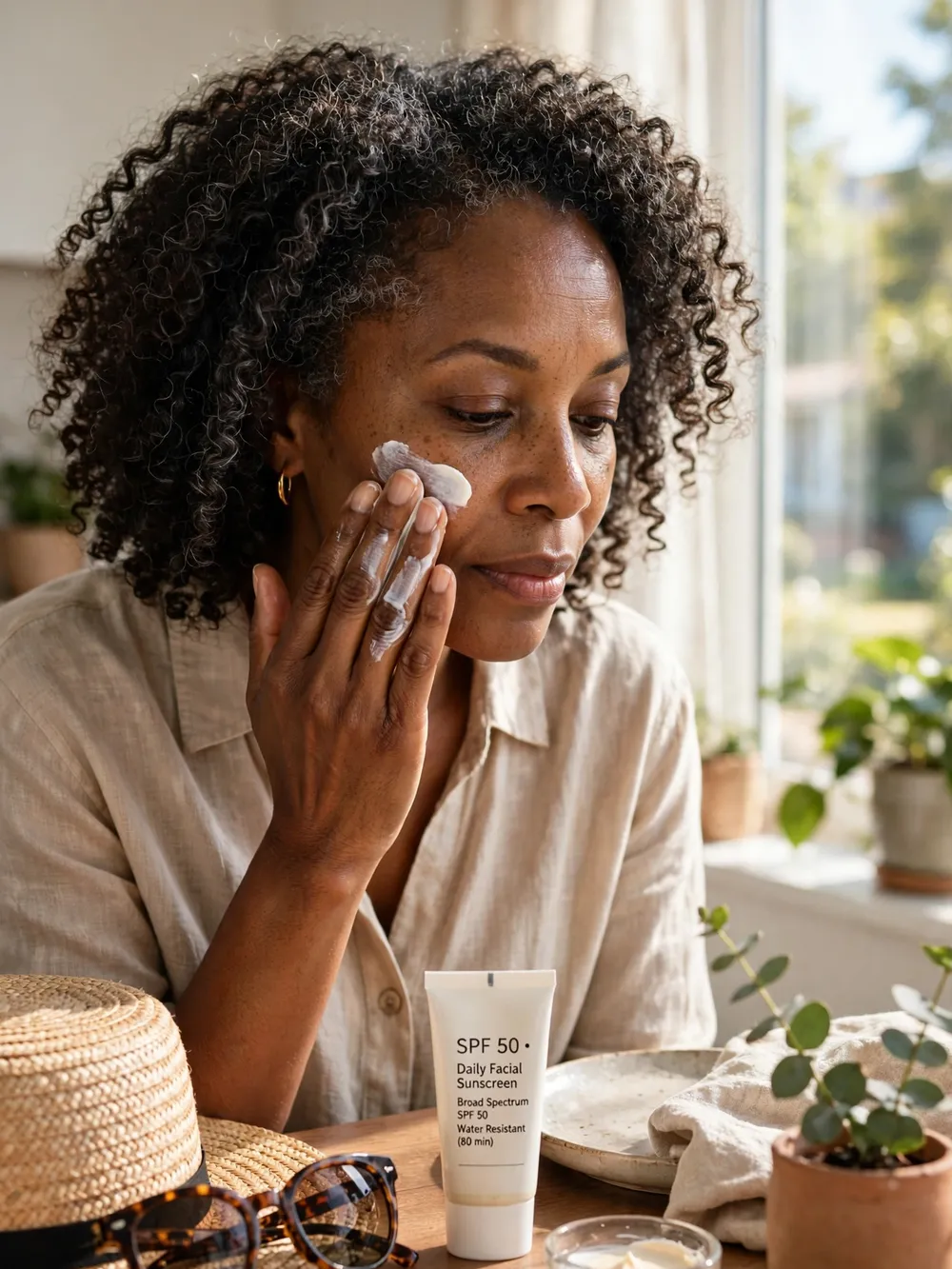
If white cast has put you off sunscreen before, try a tinted mineral sunscreen or a lightweight chemical formula made for deeper skin tones — the formulas have improved enormously, and there is no reason to settle for a grey cast anymore. And once your sunscreen is on, your makeup goes on smoother over protected skin, which is one reason these winter makeup trends for Black women look their best on a well-protected base.
9. Keep the Clashing Actives Apart
Retinol does not play well with everything in your cabinet. On retinol nights, skip vitamin C serums, AHAs like glycolic acid, BHAs like salicylic acid, and any exfoliating toner — layering them together is the fastest route to a red, peeling face. Use vitamin C in the morning instead, where it actually helps your sunscreen work harder, and keep your acids for nights when retinol is resting.

This is also the step that protects you from dark marks. Irritation from clashing actives is one of the most common causes of new hyperpigmentation on deeper skin, and it is entirely avoidable. If you are already dealing with marks from past breakouts, our guide on dark spots that won’t quit covers gentle ways to fade them while your retinol does its slower work underneath.
10. Be Patient: Real Results Take 8 to 12 Weeks
Retinol is not a weekend project. You will likely see smoother texture in about four weeks, softer fine lines around eight weeks, and real fading of dark spots somewhere between eight and twelve weeks. Take a photo in the same light once a week so you can see the change — day to day, you will swear nothing is happening, and then one morning your skin will look different in the mirror.

If you hit twelve weeks with no change at all, step up the strength slightly or check in with a dermatologist — some skin needs a prescription retinoid to see movement, and that is normal, not a failure. For most of us, though, the slow and steady version works, and the results last as long as you keep the routine going. For a deeper look at what retinol can do for dark marks specifically, our hyperpigmentation treatment guide covers the full picture, from ingredients to realistic timelines.
That is the whole of how to use retinol for black women: start low, go slow, buffer with moisturizer, protect with sunscreen, and give it time. The women who get the best results from retinol are not the ones who use the strongest product — they are the ones who use a gentle one consistently, without drama, for months. Start with the patch test tonight, build up one night at a time, and let your skin set the pace. And if your skin is glowing a little more each week, let that be the confidence habit that carries you — for more on that, these confidence tips for Black women over 40 are a good place to keep the momentum going.